Safety instructions for magnetic drills
- Do not use this tool if you or any bystanders have a cardiac pacemaker or other medical implants. Cardiac pacemakers and other medical implants may malfunction due to magnetic fields emitted by the tool, which may result in personal injury.
- Always check the safety strap for wear or damage before each use. A worn or damaged safety strap may fail unexpectedly during use and may result in personal injury.
- Only attach the magnetic drill to ferrous metal. The magnetic base will not secure properly to non-ferrous metals, such as non-magnetic grades of stainless steel.
- Clean the surface before attaching the drill stand to the work surface. Paint, rust or scale decrease the holding strength of the magnet. Chips, burrs, dirt and other foreign matter on the surface of the magnetic base will also decrease holding power.
- Always secure the magnetic base on a smooth, flat work surface. If the workpiece is uneven and not smooth or flat, the magnetic base may release from the workpiece, causing unexpected movement of the tool or workpiece and personal injury.
- Use clamps or other practical ways to secure and support the workpiece to a stable platform. It is important to support the workpiece properly to minimise body exposure, binding, or loss of control.
- Always use the safety strap provided or recommended to secure the tool to the workpiece before turning on the drill motor. The magnetic base may release from the workpiece, causing unexpected movement of the tool or workpiece and personal injury.
- Always activate the magnetic base and make sure it is securely attached to the workpiece before turning on the drill motor. Failure to secure the magnetic base to the workpiece may cause unexpected movement of the tool or workpiece and personal injury.
- Always ensure the workpiece is in a fixed or stable position. Unexpected movement of the workpiece may result in personal injury.
- Make sure you are in a stable position and able to control the tool while releasing the tool from the workpiece. A loss of control upon releasing the tool from the workpiece may result in personal injury.
- Keep your hands out of the drilling area while the tool is running. Contact with rotating parts or chips may result in personal injury.
- Make sure the bit is rotating before feeding into the workpiece. Otherwise the accessory may become jammed in the workpiece causing unexpected movement of the workpiece and personal injury.
- Do not use excessive feed force while drilling. Use of excessive feed force may cause the magnetic base to release from the workpiece, causing unexpected movement of the tool or workpiece and personal injury.
- Avoid generating long chips by regularly interrupting downward pressure. Sharp metal chips may cause entanglement and personal injuries.
- Never remove chips from the drilling area while the tool is running. To remove chips, move the bit away from the workpiece, switch off the drill motor and wait for the bit to stop moving. Use tools such as a brush or hook to remove chips. Contact with rotating parts or chips may result in personal injury.
- When performing drilling that requires the use of cutting fluid, route the cutting fluid away from the operator’s work area or use a liquid collection device. Such precautionary measures keep the operator’s work area dry and reduce the risk of electric shock.
- When the bit is jammed, stop applying downward pressure and turn off the tool. Investigate and take corrective actions to eliminate the cause of bit jamming.
- When restarting a drill in the workpiece, check that the bit rotates freely before starting. If the bit is bound it may not start, may overload the tool, or may cause the drill stand release from the workpiece.
- Do not deactivate the magnetic base until the tool is turned off and the bit has come to a complete stop. Premature deactivation of the magnetic base may cause unexpected movement of the tool or workpiece and personal injury.
- Operate power tool by insulated grasping surfaces, when performing an operation where the cutting accessory may contact hidden wiring or its own cord. Cutting accessory contacting a “live” wire may make exposed metal parts of the power tool “live” and could give the operator an electric shock.
- When drilling through walls or ceilings, ensure to protect persons and the work area on the other side. The bit may extend through the hole or the core may fall out on the other side.
- The coolant tank may not be used when drilling into vertical or sloped surfaces, or drilling overhead. Please use foam coolant. Take care that no water penetrates the tool. If water penetrates the power tool there is an increased risk of an electric shock.
- Do not wear gloves. Gloves may be entangled by the rotating parts or chips leading to personal injury.
- Accessories with speed ratings must be rated at least equal to the maximum speed marked on the power tool. Accessories running faster than their rated speed can break and fly apart.
- Use suitable detectors to determine if utility lines are hidden in the work area or call the local utility company for assistance. Contact with electric lines can lead to fire and electric shock. Damaging a gas line can lead to explosion. Penetrating a water line causes property damage or may cause an electric shock.
- Never operate the power tool without the portable residual current device (PRCD) included in delivery.
- Before beginning work, check that the portable residual current device (PRCD) is functioning properly. Have any damaged portable residual current devices (PRCDs) repaired or replaced by a Bosch after-sales service centre.
- Wear non-skid shoes. This prevents injuries that can occur from slipping on smooth surfaces.
- Never leave the tool unattended before it has come to a complete stop. Drilling tools that are still running can cause injuries.
- Keep the drill cord away from the work area. Damaged or entangled cords increase the risk of electric shock.
- Do not overload the power tool or climb or stand on it. Overloading or standing on the power tool can raise its centre of gravity, causing it to tip over.
- A mains operated power tool must only be operated on a mains supply with protective conductor and adequate dimensioning.
- When using the power tool for overhead applications, two persons are always required.
- Danger of the power tool falling down due to sudden pendular motion of the power tool. When working on a scaffold, the power tool can be subject to a sudden pendular motion when the drill starts or in case of a power failure. Secure the power tool with the provided safety strap. Secure yourself against falling down by applying a safety rope/belt.
- Keep the work surface clean, including the workpiece. Sharp-edged drilling chips and other objects may cause injury. Material mixtures are particularly hazardous. Light metal dust may catch fire or explode.
- Do not touch the application tool after working before it has cooled. The application tool becomes very hot while working.
- Do not touch the drill core that will be automatically ejected through the guide pin once the work process has ended. The drill core can become very hot.
- Metal chips are often very sharp and hot. Never touch them with bare hands. Clean up with a magnetic chip collector and a chip hook or other appropriate tool.
- Check the cable regularly and have a damaged cable repaired only by an authorised customer service agent for Bosch power tools. Replace damaged extension cables. This will ensure that the safety of the power tool is maintained.
- Never use the power tool if the cable is damaged. Do not touch the damaged cable and pull out the mains plug if the cable is damaged while working. Damaged cables increase the risk of an electric shock.
- The retention of the magnets depends on the thickness of the workpiece. They hold best on low-carbon steel with a thickness of at least 20 mm. When drilling into thinner steel, an additional steel plate (of at least 100 x 200 x 20 mm) must be placed under the magnetic base. Ensure that the steel plate cannot fall off.
- Other units used on the same receptacle will cause uneven voltage that could lead to the magnet releasing. Always use the power tool alone on the receptacle.
- Avoid operating annular cutters without coolant fluid. Always check coolant level before operating.
- Protect the motor. Never allow coolant fluid, water, or other contaminants enter the motor.
- Never attempt to use the power tool with incorrect current or abnormally low voltage. Check the nameplate of the power tool to ensure that correct voltage and frequency are used.
- Store the power tool safely when it is not in use. The storage location must be dry and lockable. This prevents the power tool from storage damage, and from being operated by untrained persons.
- Connect the power tool to a mains supply that is properly connected to earth. The socket and extension cable must have a fully functioning protective conductor.
- Products sold in GB only:
Your product is fitted with an BS 1363/A approved electric plug with internal fuse (ASTA approved to BS 1362).
If the plug is not suitable for your socket outlets, it should be cut off and an appropriate plug fitted in its place by an authorised customer service agent. The replacement plug should have the same fuse rating as the original plug.
The severed plug must be disposed of to avoid a possible shock hazard and should never be inserted into a mains socket elsewhere.
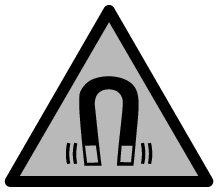
Keep the magnet away from implants and other medical devices, e.g. pacemakers or insulin pumps. The magnet generates a field that can impair the function of implants and medical devices.
- Keep the power tool away from magnetic data carriers and magnetically sensitive equipment. The effect of the magnet can lead to irreversible data loss.